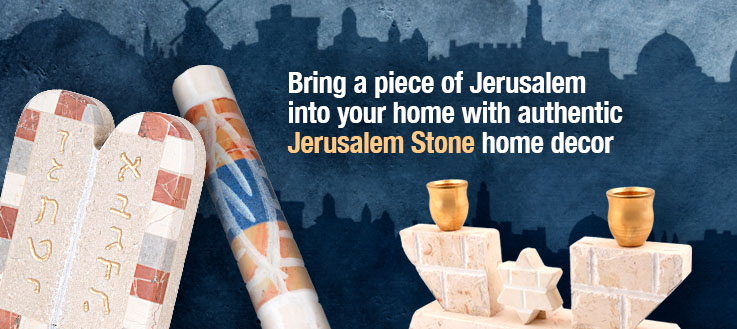
Jerusalem stone is the foundation of ancient architecture in the holy city. Its limestone origin ties every mezuzah or Hanukkah menorah directly to Jerusalem’s landscape. Authenticity matters. True Jerusalem stone comes from quarries surrounding the city, including historic quarries such as Zedekiah’s Cave, whose stone provided the building blocks for the Temple Mount and the Western Wall. Skilled artisans, like Lion of Judah Studio work with this stone for its durability and beauty, but above all for what it represents: a lasting reminder of Jerusalem’s holiness, then and now.

History Corner
Zedekiah’s Cave, also known as Solomon’s Quarries, is a vast underground limestone quarry beneath the Old City of Jerusalem, extending from near the Damascus Gate northward under the city. Archaeological evidence shows that it was actively quarried during the Second Temple period, particularly under King Herod the Great, when large amounts of meleke limestone were needed for his monumental rebuilding of the Temple and the city. Alongside this well-established history, tradition links the cave to the biblical account of King Zedekiah, who is said to have attempted to escape Jerusalem through an underground passage during the Babylonian siege, fleeing toward Jericho before being captured by Nebuchadnezzar’s forces. Whether history or legend, the story adds a dramatic human layer to the site, where solid archaeological evidence and ancient memory meet beneath the streets of Jerusalem.

White limestone or meleke
Contemporary artists are drawn to working with white limestone, creating Judaica and sculptural objects that echo Jerusalem’s ancient stonecraft. Known historically as meleke, this fine-grained limestone was prized in antiquity for being soft and workable when freshly quarried, yet durable once exposed to air. Its smooth texture and light color made it ideal for ritual objects, decorative elements, and finely finished stonework during the Second Temple period, linking modern artistic practice directly to the material traditions of the past.
Red limestone and mizzi ahmar
Red limestone found in and around Jerusalem encompasses a range of stones that vary from soft pink to deep reddish hues, the result of differing iron content within the rock. Among these, mizzi ahmar emerges as a distinct and recognizable variety, known for its density and strength. In antiquity, those properties made it the stone of choice for foundations and load-bearing elements. Today, artists and designers are drawn to mizzi ahmar not only for its durability, but also for its warm, earthy color and tactile surface, which lend depth and presence to sculptural and design pieces.